
Buying Guides
Fiberglass vs Wood vs Steel Entry Doors: Which Suits Ontario Homes?
Steel is the strongest and cheapest, wood is the classic, and fiberglass sits in between. Here is how the three compare on insulation, upkeep, security, looks and cost, and how to match a material to your entrance.
By EHI Custom Doors
Key Takeaways
- Steel costs least and resists force best, but dents can let rust start. Wood has the classic look but needs the most upkeep. Fiberglass resists dents, rust and rot and costs more than basic steel.
- Insulated-core steel and fiberglass doors run about R-5 to R-6 or higher. Wood is lower. Natural Resources Canada says insulated-core doors resist heat flow better than solid ones.
- One Ontario guide puts installed prices at about $1,400 to $2,500 for steel, $2,500 to $4,500 for fiberglass and $4,000 to $7,000 or more for wood. Our custom fiberglass doors start at $2,500 installed.
- Match the material to the exposure: lake-facing and uncovered entries suit fiberglass, covered porches can suit wood, and tight budgets suit steel.
- We build only fiberglass, so we say where we are biased and where another material is the better call.
The choice between fiberglass vs wood vs steel doors comes down to what you want to trade. In short: choose fiberglass for the best all-round balance in Ontario weather, steel for the lowest price and the strongest slab against force, and wood for a natural look on a protected entrance you are willing to maintain.
We are EHI Custom Doors, and we build only fiberglass. We manufacture and install custom front doors and back doors, so we are not neutral. This guide compares all three materials fairly and says where wood or steel is the better fit.
Fiberglass vs Wood vs Steel Doors at a Glance
| Fiberglass | Wood | Steel | |
|---|---|---|---|
| Rot and warping | Does not rot, and resists warping | Can swell, warp and rot | Does not rot or swell |
| Rust and dents | Does not rust and resists dents. A hard impact can crack it. | Dents and scratches can be sanded out | Dents, and scratches can let rust start |
| Insulation | Foam core, about R-5 to R-6 or higher | Lowest of the three, about R-2 in one guide | Foam core, about R-5 to R-6 or higher |
| Upkeep | Cleaning and occasional finish care | Regular sealing or refinishing | Touch-ups to prevent rust |
| Strength against force | Solid, and it depends on frame and lock | Moderate, depends on thickness and core | Highest for the slab |
| Look | Wood-grain or smooth, many styles and shapes | Real wood grain and feel | Smooth, with fewer design choices |
| Installed cost, one Ontario guide | $2,500 to $4,500 | $4,000 to $7,000 or more | $1,400 to $2,500 |
| Best for | Exposed entries and low upkeep | Protected entries and real-wood lovers | Tight budgets and security first |
R-values come from Bob Vila for steel and fiberglass and from This Old House for wood. The price ranges come from a Windows Canada guide for Ontario and reflect one contractor's estimates. Treat them as a rough guide.
Fiberglass Doors
A fiberglass door is a moulded fiberglass skin over an insulating foam core, on a frame that does not rot. It does not rust or swell, resists dents and needs little upkeep. Its limits are that a hard impact can crack the skin, strong sun can fade a finish, and it costs more than a basic steel door. Our guide to the advantages of fiberglass doors covers both sides in full, and our guide to fiberglass door care and maintenance covers the upkeep.
Wood Doors
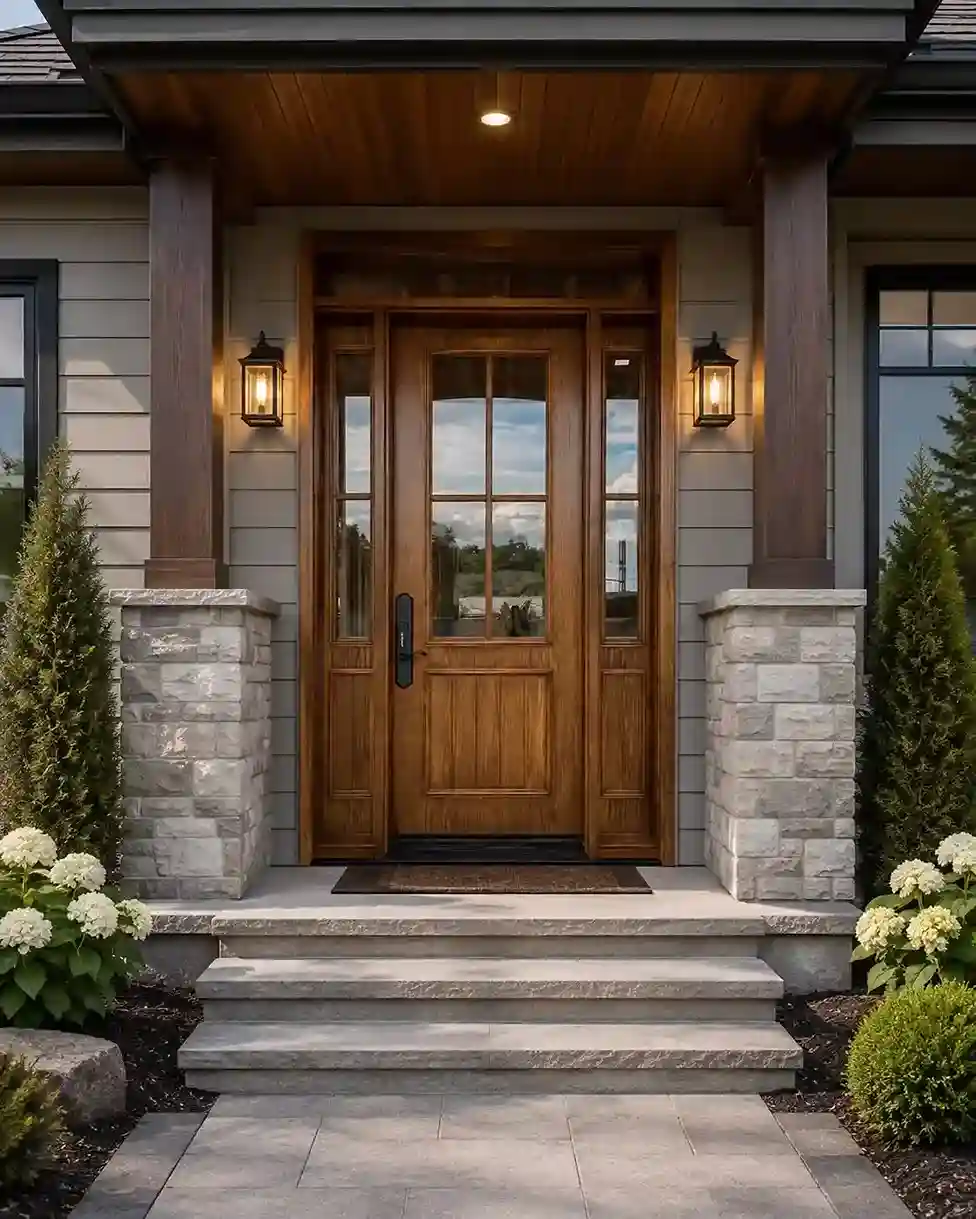
Wood is the original entry door, and a well-made, well-kept wood door can last many decades. It has a natural grain that nothing else matches, and scratches can be sanded out and refinished. Some heritage properties also favour it.
The trade-off is upkeep. Wood swells in humid weather, shrinks in dry winter air and rots where water sits, so it needs regular sealing or refinishing. It also insulates less than an insulated-core door. Wood suits a deep, covered porch and an owner who enjoys the care. It suits an exposed entry that faces wind and sun far less.
Steel Doors
Steel is the value and strength choice. A heavy-gauge steel door resists force better than the other two slabs, and it usually costs the least. A steel door with an insulated core insulates well, and it does not rot or swell.
Its weak points are the surface and the fit. A dent breaks the finish, and a scratched or chipped spot can let rust start, especially where salt and slush collect at the bottom edge. A steel skin also conducts cold, so the core and the seals matter. Steel is harder to cut to fit an odd opening and offers fewer design choices.
How Ontario Weather Treats Each Material
| Weather stress | Fiberglass | Wood | Steel |
|---|---|---|---|
| Humid summers | Holds its shape | Swells and can stick | Holds its shape |
| Freeze-thaw cycles | Holds its shape | Moves with moisture and stresses the finish | Holds its shape |
| Road salt and slush at the threshold | Does not rust | Soaks up moisture if the finish is worn | Rusts where the paint is chipped |
| Lake wind and spray | Handles it | Needs protection and upkeep | Needs a sound finish |
| Long sun exposure | The finish can fade over time | The finish wears and needs renewing | The paint can fade over time |
Homes along the lake, such as those in The Beaches and the Scarborough Bluffs, take the most wind and spray. A door with no porch cover ages fastest, whatever it is made of. Our guide on when to replace an exterior door shows what failure looks like on each material.
Insulation and Energy Efficiency
Natural Resources Canada says doors with an insulated core are more thermally resistant than doors made of a solid material such as wood, and that windows, doors and skylights together can account for up to 35 percent of a home's heat loss. Insulated steel and fiberglass are close on paper. Our CFC-free polyurethane foam core is specified at six times the insulation of a traditional wood door.
The slab is only part of it. Glass, seals and installation change how the whole door performs, so ask for the tested rating of the exact door you are buying. Our guide to energy efficient entry doors explains the ratings, and our guide on custom doors vs stock doors explains what to ask.
Security
Steel is the strongest slab against extreme force. Wood is moderate and depends on thickness and core. Fiberglass has a solid core and holds up well, but it can fracture under extreme force. In real break-ins the weak point is usually the frame and the lock, not the slab. A solid frame, a multipoint lock system and glass placed away from the handle matter more than the material. EHI doors can be built with a multipoint lock system.
What Each Material Costs in Ontario
The ranges in the table above put steel lowest, fiberglass in the middle and wood highest, installed. Wood also carries a running cost in refinishing, which the sticker price hides. At EHI Custom Doors a custom fiberglass single door starts at $2,500 installed and a double door starts at $5,100 installed. These are starting prices, and our guide to custom exterior doors cost in Toronto shows what moves the final number.
Which Material for Which Home
| Your situation | Best fit |
|---|---|
| Lake-facing or uncovered entry that takes wind and sun | Fiberglass, or well-protected steel |
| Deep covered porch, and you enjoy refinishing real wood | Wood |
| Tight budget, or security is the top priority | Steel |
| Wood look without the refinishing | Fiberglass |
| Odd-sized opening, arched top or curved shape | Custom fiberglass or wood. Steel is hard to cut to fit. |
| Designated heritage home | Ask Heritage Planning first, since some guidelines favour wood |
| Rental or a quick resale where the door only has to be sound | Steel |
If your home is designated, check the rules before you choose. Our notes on Toronto permit and heritage rules explain how the City handles a door replacement, and our guide to heritage home door replacement walks through the full process.
Where We Are Biased, and Where We Are Not
We chose fiberglass because it gives us wood grain, insulation, low upkeep and custom shapes in one door, and because we can back it with a lifetime warranty on the fiberglass slab, frame and brickmould. Browse our door catalogue and photos of doors we have installed to judge the look yourself.
We do not pretend fiberglass wins everywhere. If you want solid real wood on a sheltered porch, or the lowest price and maximum strength, wood or steel may suit you better. Customers describe their experience with us on our reviews page.
Get a Price for a Custom Fiberglass Door
Send photos of your entrance and we will give you a real price. Call EHI Custom Doors at 647-952-2311 or request a quote. We are open Monday to Sunday, 9 AM to 5 PM, and there is no pressure to book on the spot.
Fiberglass vs wood vs steel doors has no single winner. Match the material to your exposure, your budget and how much upkeep you want, and the choice gets simple.
Frequently Asked Questions
Which is better, a fiberglass, wood or steel entry door?
It depends on your priorities. Fiberglass gives the best balance of low upkeep, insulation and weather resistance. Steel costs least and resists force best. Wood has the classic look but needs the most upkeep.
Which entry door material lasts the longest?
Published lifespans vary a lot with build quality, exposure and care. Fiberglass does not rot or rust, a well-kept wood door can last many decades, and steel lasts as long as its finish stays sound.
Which door material is the most energy efficient?
Insulated-core steel and fiberglass doors are close, around R-5 to R-6 or higher, and both beat wood. Natural Resources Canada says insulated-core doors resist heat flow better than solid ones. Glass, seals and installation also affect the whole door.
Which entry door is the most secure?
A steel slab resists extreme force best. In practice, the frame and the lock decide security more than the slab, so a solid frame and a multipoint lock system matter on any material.
Which door needs the least maintenance?
Fiberglass. It needs cleaning and occasional finish care. Steel needs touch-ups to prevent rust, and wood needs regular sealing or refinishing.
Which entry door material is the cheapest?
A basic steel door usually costs the least. One Ontario guide puts installed prices at about $1,400 to $2,500 for steel, $2,500 to $4,500 for fiberglass and $4,000 to $7,000 or more for wood.
Do fiberglass doors look like real wood?
Embossed wood-grain finishes in oak and mahogany read as real wood from the street. Wood still has a natural feel some owners prefer up close.
What is the best door material for Toronto weather?
For an exposed entry, fiberglass or a well-protected steel door handles humid summers, freeze-thaw cycles, salt and wind best. Wood suits a covered porch and an owner who is happy to refinish it.
Ready to See Real Pricing for Your Home?
Explore the pages below or request a free quote and we will get back to you with an accurate number.