
Buying Guides
Custom Doors vs Stock Doors: Why Go Custom
A stock door is built to a standard. A custom door is built to your home. Here is what that difference means for fit, comfort, security, cost and lifespan, and when a stock door is still the smarter buy.
By EHI Custom Doors
Key Takeaways
- A stock door is built in standard sizes. A custom door is built to your measured opening, which matters most in older or non-standard homes.
- Custom wins on fit, design choice, sealing and long-term performance. It costs more up front and takes weeks, not days.
- Custom does not automatically mean energy efficient. Ask any maker for the tested rating of the exact door and glass you are buying.
- In Toronto, replacing a door in the same opening of a house usually needs no permit. A changed opening or a heritage property is a different story.
- A stock door is still the right call for a square, standard opening when budget or timing comes first.
When you compare custom doors vs stock doors, it comes down to one question: does a standard size fit your opening, and is a door made for it worth the extra wait? A stock door is built in common sizes and sold as it is. A custom door is built to your measurements, your style and your performance needs.
We are EHI Custom Doors. We have built entry doors for GTA homes for over 20 years, and today we manufacture, supply and install custom fiberglass front doors and back doors from our workshop in Whitchurch-Stouffville. This guide covers every reason to go custom, what it costs, and the cases where a stock door is the better buy.
Custom Doors vs Stock Doors: What Is the Difference?
A stock door is made ahead of time in fixed sizes and styles, then sold from inventory. A custom door is made after you order, to your opening and your choices. The table below shows where the two differ most.
| Factor | Stock door | Custom door |
|---|---|---|
| Size | Common sizes only, often about 36 by 80 inches | Built to your exact opening, including non-standard sizes |
| Design | A fixed range of styles, glass and finishes | Style, glass, sidelights, transom, arch and hardware chosen by you |
| Frame | Prehung units ship with a frame in a set size. A slab alone must be fitted to your old frame | Frame, slab and brickmould built as one matched set |
| Fit and seal | Depends on how close the standard size is to your opening | Built to the measured opening, so gaps are designed out |
| Lead time | Often available in days, and special orders can take a few weeks | At EHI, 4 to 6 weeks, plus 1 to 2 weeks for custom glass |
| Price | Lower entry price | Higher entry price. At EHI, single doors start at $2,500 installed |
| Installation | You, a contractor, or a store's partner installer | The same team that built it, at EHI |
| Warranty | Set by the brand. Read what it excludes | At EHI, lifetime on the fiberglass slab, frame and brickmould |
Same idea, different words
Prebuilt, off-the-shelf, standard-size and most prehung doors all describe the same idea here: a door made in fixed sizes and stocked ahead of time. That is what this guide means by a stock door.
A Door Built to Your Actual Opening
A custom door fits because it is made after your opening is measured, not before. Stock doors come in a short list of sizes. Most exterior doors are about 36 inches wide and 80 inches tall, with 32 and 30 inch widths for narrower openings. That works when your frame was built to match, and many homes were not.
Older houses settle. Brick openings get cut to whatever the builder had on hand. Additions and renovations leave openings that are a little wide, a little short or slightly out of square. When a stock door meets an opening like that, the difference gets filled with shims, foam and trim. It can look fine on installation day and still leak air or stick in humid summers.
A custom door skips the compromise. Our installer takes final measurements at your home after you approve the quote, and we build the frame and slab together for that opening. Our guide to front door sizes shows how to measure your opening and what to send us.
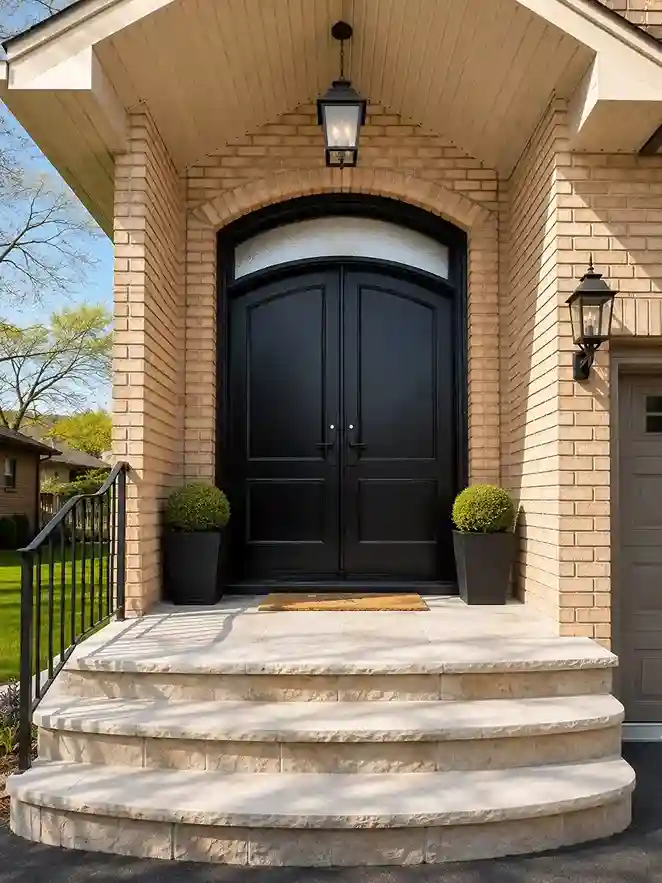
Shape matters too. Arched tops, curved transoms, extra-wide double doors and tall openings under high ceilings are rarely stock items. One customer wrote in a Google review that several other companies refused their curved front door with a matching curved transom, and that EHI took it on. You can read that review and others on our customer reviews page.
This comes up often in older Toronto neighbourhoods. Homes in The Annex and The Beaches often have entrances built long before today's standard sizes existed, which is why a made-to-measure door is usually the cleaner fix there.
Design Freedom: Style, Glass and Proportion
With a custom door you choose the design, instead of choosing from what a store happened to stock. That covers the door style and the parts around it.
- Single door, double door, or either one with sidelights and a transom
- Straight or arched tops, including curved transoms
- Executive or recessed panels, and glass inserts from one small lite to full-length glass
- Oak grain, mahogany grain, smooth and contemporary finishes, plus solid colours such as black, charcoal and espresso
- Hardware in satin nickel, oil rubbed bronze or matte black
Proportion is the part people miss. A standard 80 inch door under a tall ceiling or on a wide porch can look undersized. Sidelights, a transom or a double door give the entrance the scale the house already has, and our catalogue includes 8-foot door models as well as the standard 6 foot 8 inch height. Our wood-grain fiberglass carries the look of oak or mahogany without the refinishing that real wood needs.
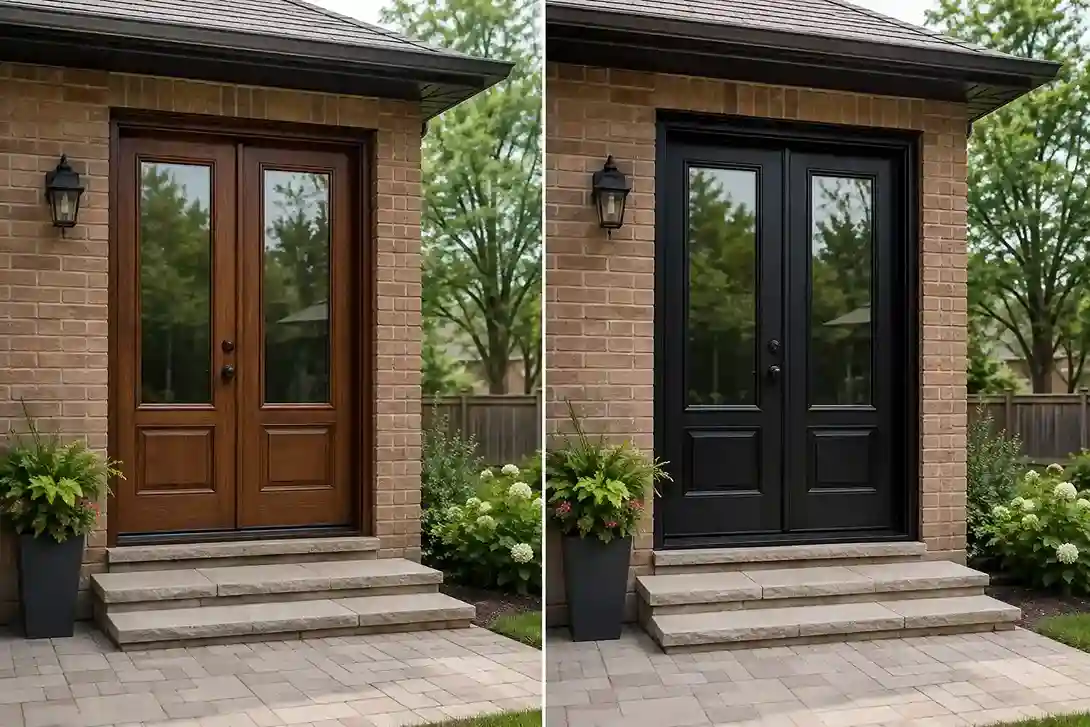
To see what is possible, browse our door catalogue or look through photos of doors we have installed across Toronto and the GTA. Not sure how much glass to choose? Our guide to exterior door glass options compares clear, frosted, textured and decorative glass, and our guide to front door styles for your home matches doors to house styles.
Better Sealing and Fewer Drafts
A door keeps heat in when its core is insulated and its gaps are sealed, and custom helps most with the second part. Natural Resources Canada says windows, doors and skylights together can account for up to 35 percent of a home's heat loss. It also says insulated-core doors resist heat flow better than solid-material doors, and that a poorly installed product can cause cold drafts even when the product itself is energy efficient.
That last point is where a made-to-measure door has an edge. It starts with fewer gaps to seal. Our doors also use a CFC-free polyurethane foam core that gives six times the insulation of a traditional wood door.
Custom does not automatically mean certified
ENERGY STAR Canada (Version 5.0, in effect since January 1, 2020) asks doors to reach a U-factor of 1.22 W/m²K or lower, or an Energy Rating of 34 or higher, with air leakage of 1.5 L/s/m² or less. Those results come from testing a specific door. Ask any maker, custom or stock, which rating belongs to the exact door and glass you are buying. Our guide to energy efficient entry doors explains U-factor, R-value and Energy Rating.
Construction That Lasts: What Is Inside the Door
A door lasts as long as its weakest part, and on many doors that part is the frame, not the slab. Wood swells, shrinks and rots where water sits at the bottom edge. Steel dents and can rust. A fiberglass skin avoids both problems, as our guide to the advantages of fiberglass doors explains, and what sits underneath decides the rest.
In an EHI door the slab, frame and brickmould are all solid composite fiberglass. Composite PVC rails run around the full perimeter with mortise and tenon joints, and a tongue-in-groove rail lock forms a moisture barrier. Some stock fiberglass doors ship in a wood or vinyl-wrapped frame, and the frame is where water collects at the sill.
Be careful with lifespan claims. You will see it repeated online that stock doors need replacing every few years. That is not true of every stock door, and a good stock fiberglass door can last a long time. The real differences are the weak points: the frame, the sill, the hardware, the glass seals and the installation.
So ask what the warranty covers. Ours is a lifetime warranty on the fiberglass slab, frame and brickmould for as long as you own the door. Hardware, glass and installation labour are not covered unless stated separately. Read the exclusions on any warranty you compare, ours included.
Security Starts at the Frame
A lock is only as strong as the frame it bolts into. A multipoint lock engages at several points along the frame instead of at one deadbolt, which spreads force across the edge of the door. EHI doors can be built with a multipoint lock system, and our back doors can also be ordered with a mortise lock. Lock type is one of the things that moves the price, as our guide to custom exterior doors cost in Toronto explains. Our guide to front door security covers the frame, strike plate, hinges and glass in full.
On a custom build the frame is made to receive that hardware. On a stock door you get the hardware options the brand offers for that model. Glass matters as well. Clear, privacy and decorative glass are all available, so you do not have to trade light for privacy on a door or sidelight that faces the street.
One Team Handles the Measuring, Building and Installing
A door is only as good as its installation, and it helps to know who to call if something is off. With many stock purchases the door comes from a manufacturer, the sale comes from a store and the install comes from a contractor. If a draft or a leak shows up later, the three can point at one another.
EHI Custom Doors manufactures, supplies and installs every door ourselves, with no dealers and no subcontractors. Customers often mention the install team by name in their reviews, and that is the accountability we mean. Our guide to door manufacturer vs dealer shows how to check any company.
Does a Custom Door Add Value to Your Home?
A new entry door usually helps resale, but the numbers say less about custom versus stock than sales pitches suggest. The best public data is the 2025 Cost vs. Value Report from Zonda, which tracks projects in the United States. It ranked steel entry door replacement second among all projects, recouping about 216 percent of its cost at sale. A large fiberglass grand entrance project recouped about 85 percent.
We are not aware of an equivalent Canadian study, and US figures are only a rough guide for Ontario. Two lessons hold anyway. A new entry door is one of the better-returning exterior projects. And the cheapest job showed the highest percentage, so do not buy a custom door as a financial play. Buy it for the fit, comfort, security and look you will live with every day, and treat any resale gain as a bonus.
Built for Toronto Weather and Toronto Rules
Doors in the GTA face humid summers, hard freezes, repeated freeze-thaw cycles and, near the lake, strong wind and spray. Materials that swell or warp fail first. Homes along the shoreline, such as those in The Beaches and the Scarborough Bluffs, take the most exposure.
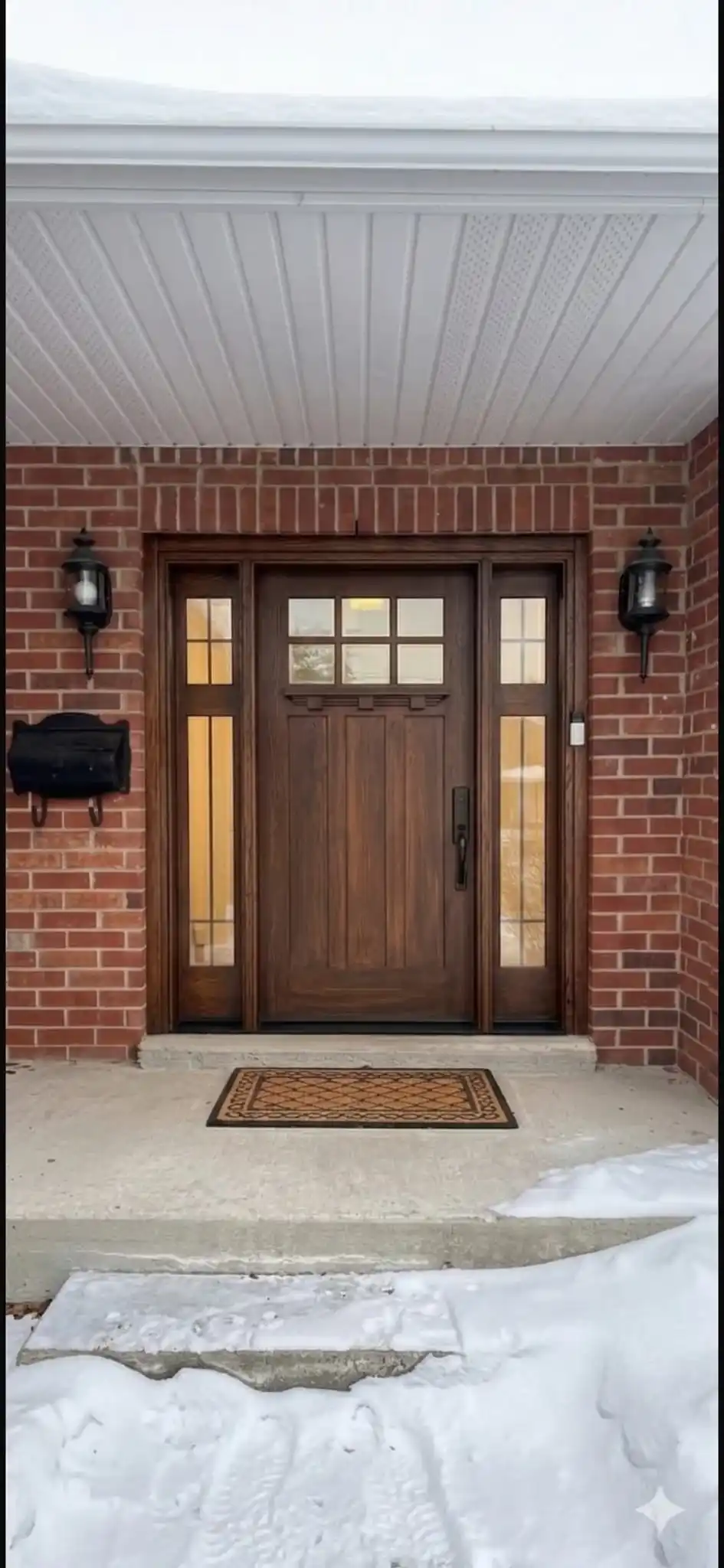
Do You Need a Permit to Replace a Door in Toronto?
- Same opening, single-dwelling home: the City of Toronto says replacing a door in an existing opening of a detached, semi-detached or row house with one dwelling unit does not need a building permit, as long as the location and size of the opening stay the same, the structure is not affected and no new exit is created.
- Bigger or new opening: widening an opening, cutting a new one or turning a window into a door falls outside that exemption. Check with the City before work starts.
- Heritage properties: if a home is designated under Part IV of the Ontario Heritage Act, a heritage permit is needed when the change affects the property's heritage attributes. In a Heritage Conservation District, replacement doors go through the building permit application, where Heritage Planning reviews them. Parts of Rosedale are Heritage Conservation Districts. Our guide to heritage home door replacement covers the process in full.
- Outside Toronto: other GTA municipalities run their own permit process, so call your town's building department.
Check before you order
Permit rules change. For a heritage home or any change to the opening, confirm with the City before you order, because a door built to one opening is hard to reuse in another.
What a Custom Door Costs and How Long It Takes
At EHI Custom Doors, a custom fiberglass single door starts at $2,500 installed and a double door starts at $5,100 installed, with manufacturing and installation included and no hidden fees added later. The final price moves with the choices below.
| What you choose | How it affects the price |
|---|---|
| Size | Wider and taller doors use more material, and double doors cost more than singles |
| Glass | Larger or decorative glass adds cost, and custom glass can add 1 to 2 weeks |
| Finish | Wood-grain and colour choices change the finishing work |
| Hardware | Handle sets and finishes range from basic to premium |
| Sidelights and transoms | Each extra panel adds material, glass and build time |
Here is the honest trade-off. A basic stock door will nearly always cost less to buy than a custom fiberglass door, and it can be in your hands within days. Custom asks you to wait: 4 to 6 weeks from a confirmed order, and 1 to 2 more weeks if you choose custom glass that is not readily available. If the up-front cost is the hurdle, we offer 6-month no-interest financing through Financeit Canada. Planning around winter? Our fall door replacement guide shows when to confirm an order. For a full price breakdown by door type, see custom exterior doors cost in Toronto.
When a Stock Door Is the Right Choice
We build custom doors, and we still tell people when stock is the better answer. Prehung doors work well when the opening is a standard size. A stock door makes sense when:
- Your frame is square, solid and a standard size, so a new door can drop into it
- Your budget is fixed and a lower entry price matters more than the extras
- You need a door within days, not weeks
- You are preparing a rental or a quick sale and the door only has to be sound and neat
- The door is a secondary entrance where design matters less
Even then, look at the frame. If it is warped, cracked or rotted, a new stock slab in a bad frame will not solve the problem, and replacing the frame changes the math. Our guide on when to replace an exterior door shows how to tell.
Custom or Stock: A Quick Way to Decide
| Your situation | Better fit |
|---|---|
| Opening is non-standard, arched, extra wide or out of square | Custom |
| You want sidelights, a transom or a specific glass design | Custom |
| You want a matched frame and slab you can trust for years | Custom |
| You want one company responsible for the door and the install | Custom |
| Opening is a standard size in good condition | Stock is fine |
| You need the door in days, not weeks | Stock |
| Your budget is tight and the look is secondary | Stock |
| The door is temporary or for a quick resale | Stock |
How Ordering a Custom Door Works
Custom sounds slow and complicated, so here is how it works at EHI Custom Doors:
- Request a digital quote by uploading photos or filling in the online form. No appointment is needed.
- Choose your design online. The price updates with each choice.
- Approve the quote before anything is built.
- Our installer visits for the final measurements.
- We build the door, install it and do a quality check.
Ready to start? Call EHI Custom Doors at 647-952-2311 or request your quote. We are open Monday to Sunday, 9 AM to 5 PM, and there is no pressure to book on the spot.
Questions to Ask Any Door Maker Before You Buy
These questions work for any company, ours included. The answers tell you more than the brochure does.
- What are the slab, frame and brickmould made of?
- Is the frame included, and is it matched to the door?
- Who measures, who builds and who installs?
- What does the warranty cover, and what does it leave out?
- Which tested energy rating applies to this exact door and glass?
- What is the full lead time, including custom glass?
- What does the quoted price include?
- Who do I call if something is wrong after installation?
Custom doors vs stock doors is not a contest with one winner. It is a match between your opening, your budget and your timeline. If your opening is standard and square, a good stock door may be all you need. If it is not, or you want a door designed for your home, custom is worth the wait.
Frequently Asked Questions
What is the difference between a custom door and a stock door?
A stock door is built in standard sizes and styles and sold from inventory. A custom door is built to your measured opening and your design choices after you order. At EHI Custom Doors, a custom door comes with a frame and slab built together as a matched set.
Are custom doors more expensive than stock doors?
Usually yes, up front. At EHI Custom Doors, single doors start at $2,500 installed and double doors start at $5,100 installed. The final price depends on size, glass, finish, hardware and any sidelights.
How long does a custom door take?
At EHI Custom Doors the standard lead time is 4 to 6 weeks from a confirmed order. Doors with custom glass that is not readily available can take 1 to 2 weeks longer.
Do I need a permit to replace a front door in Toronto?
Not when you replace a door in the same opening of a detached, semi-detached or row house with one dwelling unit, and the opening's location and size and the structure stay the same. A changed opening or a heritage property is different, so check with the City of Toronto before you order.
Can a custom door fit an old or crooked frame?
Yes, because a custom door is built to the measured opening. If your existing frame is square and solid, a new door can install into it. If the frame is warped or damaged, it should be replaced too, which is why we build the frame and slab as a matched set.
Are custom fiberglass doors energy efficient?
They can be. A foam core and a tight fit both help. Energy performance is confirmed by testing, so ask for the tested rating of the exact door and glass you are buying, whether it is custom or stock.
Will a custom door increase my home's value?
It can help, but nobody can promise a number. In 2025 US data from Zonda, a steel entry door replacement recouped about 216 percent of its cost and a large fiberglass grand entrance about 85 percent. Buy a custom door for daily fit and performance, and treat resale as a bonus.
Is a prehung door the same as a stock door?
Not exactly. Prehung means the door arrives already hung in its frame, and most prehung units come in stock sizes. A custom door also comes with a frame, but that frame is built to match your opening.
Ready to See Real Pricing for Your Home?
Explore the pages below or request a free quote and we will get back to you with an accurate number.